RSM US Foundation: A Case Study in Purpose-Driven Business
RSM is the fifth largest public accounting and professional services firm in the United States - behind only the Big Four (Deloitte, PwC, EY, and KPMG) - and the leading provider of assurance, tax, and consulting services specifically focused on the middle market. The firm hit $4 billion in US revenue in fiscal year 2024, up nearly 8% from the prior year. It employs more than 16,000 professionals across 81 cities in the US and Canada, with additional offices in India and El Salvador.
Where the Big Four largely serve Fortune 500 and global enterprise clients, RSM made a conscious choice to go deep on a different part of the economy. RSM defines the US middle market as companies with revenue ranging from $30 million to $10 billion RSM US - the growth-stage businesses, family-owned enterprises, private equity-backed companies, and founder-led organizations that are the engine of employment and economic dynamism in the US and globally. This deliberate market strategy is built on the insight that the middle market is underserved by firms oriented toward the Fortune 500, and that deep sector expertise and genuine partnership relationships matter enormously to clients at this stage of growth.
The firm is organized around three core service lines: audit and assurance, tax advisory, and consulting.
The firm's brand promise "The Power of Being Understood" is less a marketing slogan than a positioning statement. In a market where clients can access the full technical sophistication of Deloitte or PwC if they choose to, RSM's competitive differentiation is relational. The promise is that RSM professionals understand the specific context, growth challenges, and human complexity of the businesses they serve in a way that larger, more transactional firms do not. That promise only holds if the culture underneath it is real, which is partly why the stewardship programs, the Great Place to Work recognitions, and the employee-driven culture of giving back matter strategically, not just humanistically. The kind of people who choose to work at a firm because it genuinely gives back, and who stay because the culture is authentic, are also the kind of people who build the deep client relationships that RSM's competitive position depends on.
In short: RSM is a large, growing, century-old professional services firm that has made a deliberate bet on the middle market, built a globally expanding footprint to serve it, and developed a people-first culture as the foundation of everything - including, and especially, its community impact work.
Are your eyes glazed over yet?
Because mine are.
I consulted for RSM to revitalize their CSR strategy.
At first glance, I was uncertain.
A public accounting firm?
I had low expectations that this would be a forward-thinking and innovative company making a difference in the world, and was anticipating a lot of people wearing glasses and pocket protectors and looking to check off that they made an attempt to do some type of volunteer initiative.
I have never been more wrong.
RSM is LEADING the way in corporate social impact.
Their strategy is embedded within the culture and has created a phenomenal cultural value that creates more good in the world than a lot of mission-focused companies I’ve worked with.
In 2014, RSM did something that most professional services firms still haven't done: it made a deliberate, structural decision about how it wanted to give back. The Foundation was built with a specific intention: to create a giving strategy that was "compelling to our people, our clients and our markets" while enhancing longstanding community support in the areas where employees lived and worked. RSM US
RSM wasn't creating a philanthropic program. It was creating a business strategy with a social mission embedded in it.
The mission they landed on was sharply focused: build tomorrow's middle market leaders by expanding educational outcomes and supporting the quality of life for children and families through programs in education, hunger, housing, and health.
For a firm whose identity is defined by serving the middle market - the growth-stage and founder-led businesses that drive the American economy - this wasn't a cause picked from a list. It was a direct extension of who RSM is. The students getting financial literacy education today are the business leaders RSM will serve in a decade. The communities those students grow up in are the communities where RSM's professionals live and raise their own families. The mission is coherent because it reflects the firm.
Critically, RSM understood from the start that a foundation alone doesn't change a culture. The Foundation was designed to empower RSM professionals to make a positive impact through local partnerships and programming - meaning the program was built to channel employee energy, not replace it. That distinction is what separates RSM's model from a firm that writes a check and calls it stewardship.
How It Works
The RSM social impact ecosystem has several interlocking components that work together in a way most corporate programs don't think to design.
The Power of Love is the engine.
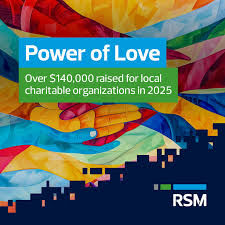
Every year, more than 70 RSM offices across the US, Canada, India, and El Salvador each select a local youth-focused charity to support through fundraising and volunteering opportunities - and the RSM US Foundation amplifies those efforts with an additional match. RSM US The culminating moment is the reveal of total impact at
This is the finance industry, so we have to sneak in golf somewhere. The RSM Classic golf tournament each November - a public, high-visibility moment that turns the annual giving campaign into an event rather than a report that no one will ever read. It creates anticipation, it creates community, and it ties RSM's name to something meaningful in front of clients, prospects, and the public at exactly the moment the firm wants to be visible. In 2024 alone, RSM's people raised more than $5 million for local organizations and volunteered more than 63,000 hours. Los Angeles Business Journal
Dollars for Doers is the mechanism that makes individual employee engagement financially consequential. Each individual employee can earn up to $2,400 in grants for the charities they personally volunteer with, and groups of RSM volunteers have limitless grant-earning potential - the more hours, the more dollars. RSM US This is intelligent design because it amplifies whatever employees already care about rather than directing them toward a corporate-chosen cause.
This is so cool because it’s generated by a CULTURE of encouraging employees to care, to be well rounded humans, to give back to their communities, to volunteer.
The interests are hugely varied - some employees care about hiking trail preservation, some about Alzheimer’s research, some about ensuring children have lunch at school. And the best part is that RSM's giving reflects the actual values of its people, not just its leadership, which makes the program feel genuinely authentic rather than top-down.
The national partnerships are the structural anchors. RSM's relationships with Junior Achievement USA and Boys & Girls Clubs of America go well beyond financial sponsorship. RSM invested more than $2.3 million to support the development of JA's Take Stock in Your Future curriculum and the Stock Market Challenge simulation, and RSM professionals now serve on local JA boards at more than 30 chapters across the US and Canada. In December 2025, the Foundation renewed that commitment with a fresh $1.35 million investment in the JA Stock Market Challenge. For Boys & Girls Clubs, RSM contributed $253,000 to BGCA's Life & Workforce Readiness Program in 2025 - a targeted investment in the specific programming that helps young people become employable adults. These are not transactional relationships. They are multi-year, co-developed partnerships where RSM's professional expertise shapes what the program can be.
The scholarship infrastructure completes the loop. In 2025, the Foundation awarded more than $900,000 in combined scholarships RSM Canada through programs including Power Your Education, First Generation, Power of Inclusion, and Power Your Transition - covering business and technology students who, in many cases, will go on to work at the kind of middle market companies RSM serves. Since 2019, the University Scholarship program alone has helped more than 420 students pursue their degrees.
Why It Works
RSM's program works because it solves the design problems that cause most corporate giving programs to stall. Participation requires active employee choice rather than passive compliance. There isn’t one dedicated CSR staff person who goes around the office trying to convince their colleagues to care about something. The program isn’t built on 5 different HR adjacent staff who were asked to take on CSR on top of their full-time job.
The financial amplification mechanism (Dollars for Doers) means that an employee's personal time creates real resources for the causes they care about - so engagement has stakes. Each employee has a personal reason they want to highlight a nonprofit organization, and they share that story and passion with their colleagues. They are the champions of the work, not a siloed CSR staff. The local structure of Power of Love means that every office is invested in its own community outcomes; they are investing in their neighbors, in the parks where their kids play, and supporting their communities. And the national partnerships give the program credibility and continuity that individual office initiatives can never achieve alone.
There is also something more fundamental at work: the mission is honest. RSM is a firm that helps middle-market businesses grow. Its Foundation builds the future talent and community infrastructure that makes those businesses possible. That coherence is what allows the stewardship narrative to be credible externally - to clients, to recruits, to the media - in a way that feels earned rather than performed.
As RSM's CFO put it: "Junior Achievement's mission of inspiring and preparing young people to succeed is in direct alignment with the RSM US Foundation's mission of building tomorrow's middle market leaders." That alignment isn't marketing language. It's the reason the program sustains.
The Impact on the Company
The external validation RSM has accumulated tells a clear story about how the market interprets a decade of genuine commitment.
In April 2025, Fortune and Great Place To Work named RSM to the Fortune 100 Best Companies to Work For - the fifth time RSM has earned the recognition. This is not a ranking based on perks or ping-pong tables. Let me remind you - this is a company of accounting professionals - not the coolest or hottest sounding company. It is based on confidential employee survey data across 60 workplace dimensions, with over 1.3 million employees surveyed nationally. RSM has also appeared on the Best Workplaces for Parents, Best Workplaces for Millennials, Best Workplaces for Women, and PEOPLE Magazine's Companies That Care list in recent years. In 2025, the Los Angeles Business Journal named RSM Community Impact Firm of the Year. Los Angeles Business Journal
On Great Place To Work's platform, 78% of RSM employees say it is a great place to work, compared to 57% at a typical U.S.-based company. Great Place To Work® That 21-point gap is not explained by compensation alone in an industry where the Big Four are competing for the same talent. Culture is doing a significant amount of that work.
The Impact on Employees
Glassdoor reviews of RSM consistently surface stewardship as a genuine differentiator, not a talking point.
If you can do your accounting work at a company that doesn’t care about you and treats you as expendable and doesn’t give back to your community OR you could do almost identical work at a company that does value you and your community, which one would you choose?
One senior associate described it directly: "They value stewardship with a desk flex day which allows each office to take off for the day for community service." Glassdoor One RSM professional who serves on her office's stewardship committee described an effect that the retention research would predict:
"Working on the audit side, we can be a little siloed at times, and being in this role has helped me with exposure to all lines of business, as well as the partner group. It's been an awesome tool in building relationships with leadership, but it's also good common ground. From a client perspective, it's been one of the greatest talking points because each organization has this social responsibility."
Volunteer engagement as a career development tool, a relationship builder across silos, and a client conversation catalyst is exactly the multiplier effect that the best programs generate. The volunteering is not separate from the professional experience. It has become part of how careers develop at RSM.
The Impact on Partner Organizations
In December 2024, more than 30,000 people across the global RSM network mobilized for RSM World Day in support of 132 community projects, from pro bono accounting and tax services for nonprofits in Austria, to digital resources for youth in India through the United Way of Hyderabad, to Power of Love activations across 70 US offices. That is a coordinated global movement of professional expertise being deployed for community benefit in a single day.
For Junior Achievement specifically, RSM's investment has been program-defining rather than merely additive. JA's CEO said directly that RSM's support of the Stock Market Challenge "has been critical in helping JA give students the tools they need to grow into financially capable adults."
The curriculum RSM funded - Take Stock in Your Future and the Stock Market Challenge simulation - puts real financial decision-making into the hands of high school students who would otherwise have no exposure to investing concepts before adulthood. 85% of Junior Achievement alumni nationally report that their JA experience helped with their financial literacy. Junior Achievement RSM helped build the program that produces that outcome. They are investing in their future clients in their future colleagues by elevating financial literacy as a whole.
For Boys & Girls Clubs, the investment goes directly into workforce readiness programming — the practical skills of employability, career exploration, and financial capability for young people in communities that need those pathways most. Total Foundation giving reached $58.8 million as of April 2026, with $7.3 million contributed in 2025 alone - and the trajectory is upward, with scholarship commitments increasing for 2026 and the JA investment renewed at $1.35 million.
The number that perhaps best captures the human dimension of this program: since the Dollars for Doers program launched in 2015, RSM professionals have volunteered more than 356,000 hours with aligned charities. RSM Canada
Those are not hours tracked on a spreadsheet to satisfy a CSR report. Those are RSM employees showing up - to schools, food banks, youth programs, and community gardens - because a well-designed program made it easy to do so and a well-built culture made it feel worth doing.
You Don’t Need Money or to Be a Fortune 500 Company or Have Dedicated Staff to Change the World - Steal the RSM Strategy
Most corporate volunteer initiatives are designed from the top down. A CSR team identifies a cause, creates a structure, emails the company, and waits for sign-ups. Participation is usually thin, recognition is usually performative, and the whole thing resets to zero the following year when the same email goes out to a slightly different audience.
The process in a typical RSM office starts with an email to the whole office, encouraging employees to share charities they are passionate about and would like to see as the official charity for the upcoming year. Once submissions are collected, a voting process determines the final selection. Hand in Hand No HR team is pre-selecting the cause. No national CSR director is mandating the charity. The office nominates, the office votes, and the office owns the outcome.
Offices host fundraising events, volunteer days, team competitions. They invite representatives from their chosen charity to speak to staff directly. RSM's Davenport office, for example, shared that
"hearing firsthand from the charity about how donations and volunteer efforts make a meaningful impact helps inspire employees to support and get involved."
That is a profoundly different experience than reading about a charity in a newsletter. It is personal. It creates a human connection between the work and the impact, and that connection is what transforms participation from an obligation into something people actually show up for.
Then the Foundation amplifies it. For every hour an employee volunteers, RSM donates $15 to the nonprofit. Donations made through the Power of Love link receive a 25% match from the RSM US Foundation.
The mechanic turns individual time and personal donations into something larger than either could produce alone. An employee who gives an afternoon gets to see that afternoon multiplied. That multiplication is motivating in a way that abstract impact reporting never is.
The culminating moment - the reveal of total impact at The RSM Classic golf tournament in November - adds something that most giving programs lack entirely: a public celebration with real stakes.
RSM's chief marketing officer described it directly: "The RSM Classic is more than a golf tournament, it's a platform for purpose. What makes this initiative so powerful is the way it brings together our people, our clients and the broader PGA TOUR community in service of something bigger than ourselves."
The Classic is a PGA TOUR event. It has media coverage, client entertainment, and public visibility. Announcing the Power of Love totals in that context is not a footnote; it is a brand moment. It’s free positive PR and brand recognition.
RSM's Foundation chair put it simply:
"I am exceptionally proud of RSM's people for consistently showing up and promoting stewardship, one of our firm's core values, in everything they do." RSM US
The phrase "consistently showing up" matters. This is not a one-year success story. Since inception, the Power of Love has raised nearly $48 million, with people volunteering nearly 294,000 hours and donating nearly $3.7 million through Dollars for Doers. RSM US In 2025 alone, the program surpassed $4 million raised. RSM US That is compounding. That is what a culture produces, not a campaign.
The People Behind It
The most revealing evidence that this is a culture rather than a program is the nature of who actually runs it. Not a CSR department. Not an HR initiative. Individual employees - in many cases junior ones - who decided to step up, organize their offices, and keep the energy alive between annual campaigns.
Two RSM employees, Taylor and Emily, met working on Power of Love in 2020 when Taylor was just starting a stewardship committee in their office. After that first season, they began thinking about how to continue the momentum and started leading the committee together. Taylor is on the audit side - not in a communications, HR, or CSR role. Emily joined RSM right out of college as an administrator. Neither of them was hired to run a volunteer program. Both of them decided to build one.
What they built matters. Their committee identified eight key nonprofit partners for ongoing monthly or annual volunteer events, connected the office's Power of Love champion to the stewardship committee so all efforts stayed coordinated, and integrated the RSM Foundation programs into their broader engagement strategy.
That is institutional thinking from people who don't have institutional titles. And the benefits they describe are not abstract. Taylor notes that leading the stewardship committee gave her exposure to every line of business and the partner group - people she would otherwise rarely encounter in audit. Emily, an administrator, found that her art skills suddenly had a venue and that creative work on community events opened doors to innovation teams she had never worked with before.
Emily said it directly:
"Doing something outside of your normal job function gives you an opportunity to showcase some skills you wouldn't normally. I joined RSM right out of college and didn't know how my art skills would translate to work at an accounting firm - but serving on the stewardship committee gives me a chance to show those skills."
The volunteer program is not just creating community impact. It is creating pathways for people to show who they are beyond their job description - to build relationships, surface skills, and develop leadership capacity in ways that formal development programs rarely achieve. A junior employee describes volunteering as the mechanism through which she found her place at the firm? That is culture, friends.
The 2025 Power of Love announcement explicitly named employee champions Samuel Kleiss and Taylor Muzinic - by name, at the firm-level, in an official press release - thanking them for the "passion and dedication" that elevated the year's efforts.For a large professional services firm to call out individual contributors by name in a national announcement is a deliberate signal: this is what we value, this is who we celebrate, and this is the behavior we want more of. It tells every other employee in the firm exactly who gets recognized at RSM - not just the highest billers, but the people who show up for their communities.
What "Culture" Actually Means at Scale
Everyone on LinkedIn has heard Peter Drucker’s famous “Culture eats strategy for breakfast”. The word "culture" gets used carelessly in corporate contexts. It usually means the aesthetic of the office or the stated values on the website. What RSM has built around stewardship is the real thing: a set of shared behaviors that reproduce themselves without requiring constant top-down enforcement.
The Power of Love is not a headquarters initiative being passively received by satellite offices. It is a cultural norm traveling - being adopted, adapted, and owned locally in every geography where RSM operates, because the people arriving at those offices have internalized the value of stewardship, not just its procedures.
RSM Canada's national managing partner captured it precisely: "Stewardship is at the heart of RSM and is critical to our culture, and our Power of Love campaign continues to demonstrate how purposeful action can drive transformative impact." RSM Canada
Purposeful action. Not mandated action. Not incentivized compliance. Purposeful action - chosen, owned, and sustained by the people who have made stewardship part of their professional identity. That is the difference between a program and a culture. And it is, ultimately, the thing that no competitor can copy by launching a giving campaign.


Comments